
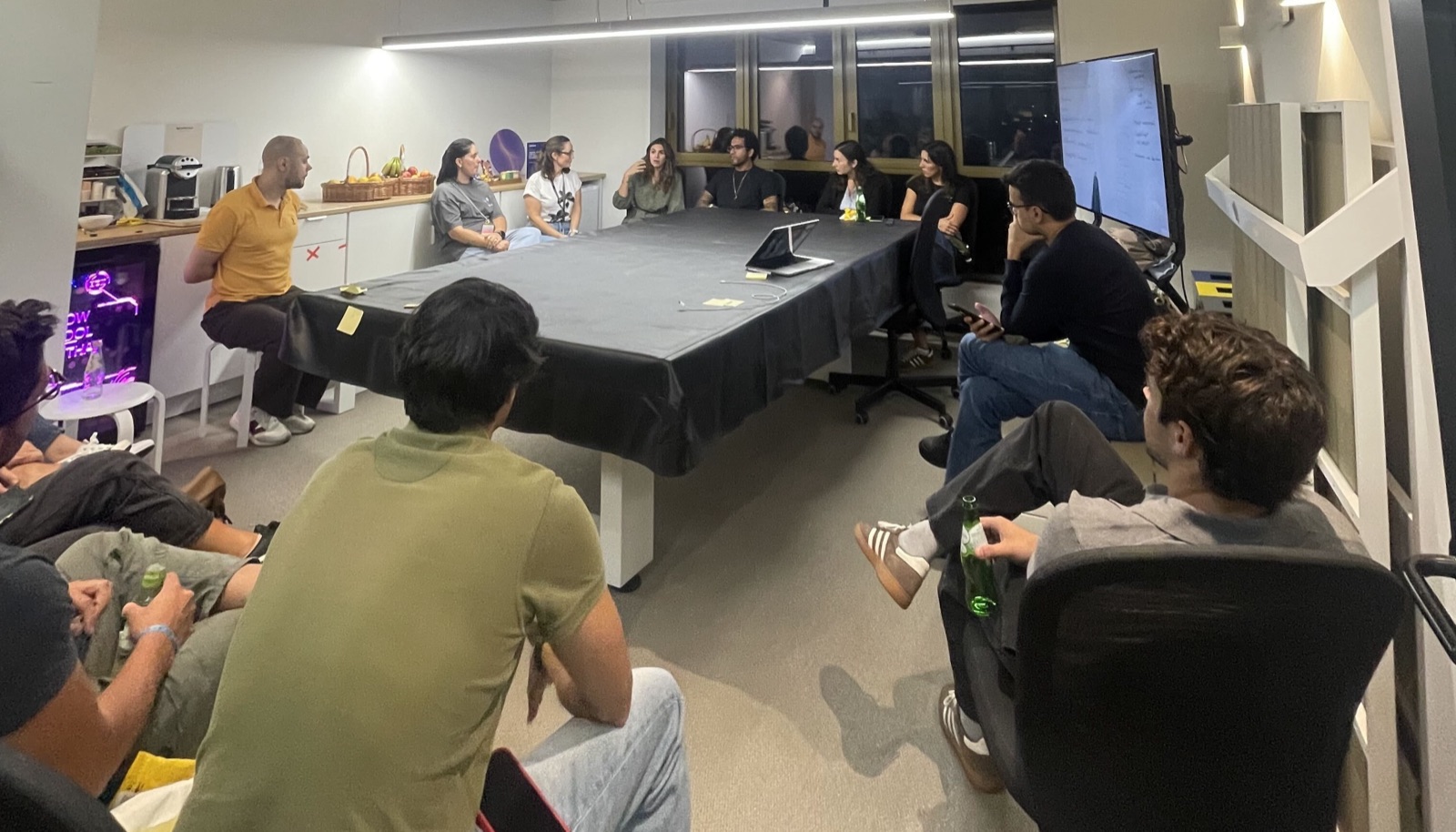
This comes out of last Tuesday's Impostor PM Club in Porto, organized and run by Catarina Ferreira. The Club is a small, off-the-record discussion, so apart from Catarina I've left out names and companies.
Catarina opened last Tuesday's Club with a simple question: has AI made product discovery better, or just faster?
The PMs around the table worked on very different things: products in highly regulated industries, security software for IT admins, AI agents for contact centers, internal platforms where every request arrives as a ticket. They'd come to product from engineering, sales, marketing, consulting and design. The clearest agreement was on the help AI gave them before and after customer conversations. Synthetic users were more divisive: some were skeptical, while others saw a useful way to learn when access to real customers was blocked.
Before the call
- Learn the customer's world in 30 minutes
- Find who already mentioned the pain
- Scan what solutions already exist
The conversation
Talking to a real customer
Where access is difficult, the role of synthetic users is still debated.
After the call
- Turn the transcript into signals
- A weekly digest of feedback channels
- A shared pool of insights
Shortcuts that skip the conversation
AI-made decks presented as evidence · mock data mistaken for real results
Getting to the conversation is still the hard part
Before anyone mentioned AI, the list of what makes discovery hard was already long, and almost none of it was technical. In B2B, customer success guards the relationship, legal wants a review, and the person who finally joins the call signed the contract but doesn't use the product. In consumer products the users are anonymous. And in a highly regulated industry you may not even be allowed to use your own product the way a customer does.

Then there's time. Discovery competes with building for the same weeks, and building usually wins, because it's what shows up in the sprint review. Add vague goals and a good dose of "vibe managing", where an idea from management turns out to be either a small tweak or a lost quarter, and discovery rarely gets the room it needs.
AI fixed none of this. Most advice about AI in discovery starts once a customer is already on the call, which skips the part PMs actually struggle with.
Before the call, AI is a cure for impostor syndrome
Talking to specialists is intimidating when you don't know most of what they know. IT admins, for example, expect to talk to a PM as an equal, and an hour with one of them can be the most valuable hour of your week. Half an hour with Claude beforehand, learning their vocabulary and their usual problems, won't make you an expert. It does mean you walk in knowing you did all you could. That's the feeling this community is named after, and it was good to hear AI help with it for once.
The same half hour works for checking which solutions already exist, or for searching old interview transcripts for customers who already mentioned the pain you're about to work on. Those customers become your first calls, which also answers "who do I even talk to?", a surprisingly hard question in B2B. At our last AI PM Meetup, Diana Ferreira showed a skill that prepares each recurring meeting automatically.
After the call, AI does the part nobody has time for
Turning an interview transcript into signals used to take a couple of hours per call. Now it takes a prompt. A scheduled job that reads every Slack channel where customer feedback lands can leave a summary in your inbox every Monday morning, which matters most when you can't use the product yourself.
The most complete setup we heard about came from a team that stopped running discovery as a project, because projects need sign-offs from half the company every time. Instead, they built it into moments that already existed:
- Ticket resolved or subscription renewed
- The same person asks for a chat
- Support runs the conversation
- Shared insight pool
- AI clusters the signals
Customers were already engaged and opened emails from someone they knew, and discovery stopped depending on one enthusiastic PM. AI only came in at the end, doing the sorting.
I pushed for taking that shared pool beyond product. Customer success, support and anyone else who knows the users should be able to feed the same knowledge base. Each conversation adds to what the company knows, and AI can search across it when the next question comes up. We spend enough time persuading customers to talk to us; we might as well remember what they told us.
That history also gives you something to bring when a stakeholder changes the priorities halfway through discovery. You can ask AI to pull together the relevant customer evidence, check the sources, and put it next to the new request: "Here's what customers have been telling us. What changed?" It won't solve the people part of prioritization, but it gives you something firmer to discuss than whose idea sounded most urgent that morning.
Synthetic users divided the room, especially when access was blocked
Some were skeptical about how much you could learn from a simulated customer. Others argued that, done well, synthetic users could be a useful way to explore more user profiles and situations than they could reach directly. Company culture, gatekeepers and other restrictions made real customer conversations difficult, sometimes impossible to arrange.
The case for them was practical: the goal of talking to users is to understand their problems and make better product decisions. Supporters saw synthetic users as a way to make progress toward that goal when access was limited. Updating the profiles with what you learn from real interviews was one way discussed to keep them grounded. The disagreement was about how far you could take that learning, and how much confidence to put in it.
AI makes a 60/40 look like a 95/5
The pain point with the most agreement was this one: leadership funds two weeks of discovery and expects a definitive answer, when what you usually get is ambiguous data and a judgment call someone has to own.
One story I found relevant was about a colleague who pitched ideas to the CEO with decks made in Claude. The decks were persuasive, the CEO wanted to know why it wasn't built yet, and the product team ended up looking like the blocker for asking questions.
The fix is to turn the same tools on that confidence: ask for the strongest counterargument, or use a challenger agent like the one Gabriel Lima showed at the AI PM Meetup. Even then, AI can gather more evidence, but someone still has to take the shot.
Prototypes moved into discovery, so timing matters more
Prototyping used to happen near the end. Now it's part of discovery, and Catarina's team at Talkdesk showed what that looks like when it works. Their customers had a problem that nothing on the market solved. Two PMs built a working version on real APIs with Claude Code, told every customer it was a prototype, and fixed bugs daily.
2
PMs built it
3 weeks
to a version customers used with their own data
~50
customers using it daily three months later
~100k
interactions a month
It was their second attempt. The first prototype solved half the problem, and that failure showed them what not to build. The catch: with 50 customers on it, half the company thinks it's already done.
Earlier in discovery, polish backfires. In another story, a prototype styled like a Power BI report and full of mock data ended up with a director taking notes on the numbers, and people kept asking how the backend had been connected long after the PM had explained there wasn't one. Even Claude pushed back when asked to build a prototype too early: a solution shown too soon biases the answers.
Put together, the stories make a rough rule: the further along you are, the more finished what you show can look.
-
Defining the problem
Show nothing yet. Ask.
-
Exploring solutions
Rough and off brand
Labeled "mock data, no backend".
-
Validating
A working version on real data
Clearly labeled as an experiment.
None of this is new. We talked about problem space and solution space long before AI, and you shouldn't show a Figma wireframe while you're still defining the problem either. What changed is that a prototype now takes an afternoon, so anyone can make one, including stakeholders who arrive with the solution already built. And AI-made interfaces all tend to look alike, which users notice.
Try this next week
- Before a customer call: "I'm interviewing an Active Directory admin tomorrow. Explain the ten terms they'll use most and the three problems they complain about most."
- Before asking for access: "Find every past interview where a customer mentioned manual data entry. List who said it and quote them."
- Every Monday: "Summarize last week's messages in these feedback channels, grouped by topic. Flag anything about onboarding or billing."
- When someone brings you an AI-made plan: "Argue against this plan as a skeptical engineering lead. What's assumed without evidence?"
Faster isn't the same as better
Catarina closed with the line that sums it up: everything has a place and a phase, and with AI we can do discovery faster, which isn't the same as better. I'd add one thing. AI also makes it much easier to look like you've done discovery, and that's the part to watch.
I still don't have a good answer for PMs who aren't allowed to use their own product. If you do, I'd love to hear it.
Thanks to Catarina for organizing the Club, and to everyone who shared their stories so openly.